These awards recognize the excellence, innovation, and dedication of individuals and teams making a meaningful impact on the field of human factors and ergonomics. From groundbreaking research and impactful design to lifetime achievements and early-career contributions, each recipient is helping advance the field and improve human well-being and performance across industries.
Thank you to everyone who submitted nominations and helped celebrate the incredible work happening across the HFES community. Your support helps recognize the achievements of others and inspires continued innovation and excellence in human factors and ergonomics.
2026 HFES Awards
Expand
Collapse
Best Human Factors in Healthcare Paper
The award is given following a careful review of all articles in the 2025 volume of Human Factors in Healthcare. Dr. Marc Friberg, Dr. Carl-Oscar Jonson, and Dr. Erik Prytz were honored with this year’s award for their study, “Prioritization of Victims With Traumatic Bleeding Among Medical Laypeople—An Experimental Study.”
Best Journal of Cognitive Engineering and Decision- Making Article
Craig J. Johnson, Robert S. Gutzwiller, Eric Holder, Polemnia G. Amazeen, and Nancy J. Cooke were honored for their entry, “Exploring the Relationship Between Team Workload and Communication in Action Teams.”
Best Ergonomics in Design Article Award
This award recognizes the best article published in the previous year’s volume. The 2026 award honors “Ergonomic Improvement at a Distribution Center Using a Voice-Directed Feedback System to Manage Loading Trucks.” The 2026 Award Winner Is David Groomas.
Best Student Paper in Ergonomics in Design Award
The award recognizes Dr. Trung Nguyen for his contributions to ergonomics in design through his research, “Designing a Glyph-Based Polar Chart to Interpret the Results of Machine Learning Models.” His work explores innovative approaches to making machine learning results easier to interpret through effective visual design.
Jerome H. Ely Human Factors Article Award
The award recognizes Dr. Xiaolu Bai and Dr. Jing Feng for their paper, “Awakening the Disengaged: Can Driving-Related Prompts Engage Drivers in Partial Automation?,” published in Human Factors. Their research examines how driving-related prompts can engage drivers using partially automated vehicles, contributing to a better understanding of driver engagement and vehicle safety.
2026 Alphonse Chapanis Award

Amanda Newendorp
Iowa State University
“What is the Best Word to Describe AI Uncertainty: Confidence, Certainty, Reliability, or Accuracy?”
This award is presented to a student or students for outstanding human factors research conducted while enrolled in an appropriate academic program and presented as a paper or poster at the HFES Annual Meeting.
Inclusion Award for Practice

Rich Holden, PhD
Professor and James A. Caplin, M.D. Chair of Evidence-Based Public Health
Indiana University-Bloomington School of Public Health
Dr. Rich Holden is recognized for applying human factors and ergonomics to advance health equity through programs that support patients, caregivers, health systems and communities. His research addresses critical issues, including food insecurity, medication safety, dementia care and accessibility, with a focus on sustainable, real-world impact. Through inclusive hiring and mentoring initiatives, he also supports early- and mid-career faculty, including scholars from underrepresented groups.
Inclusion Award for Research
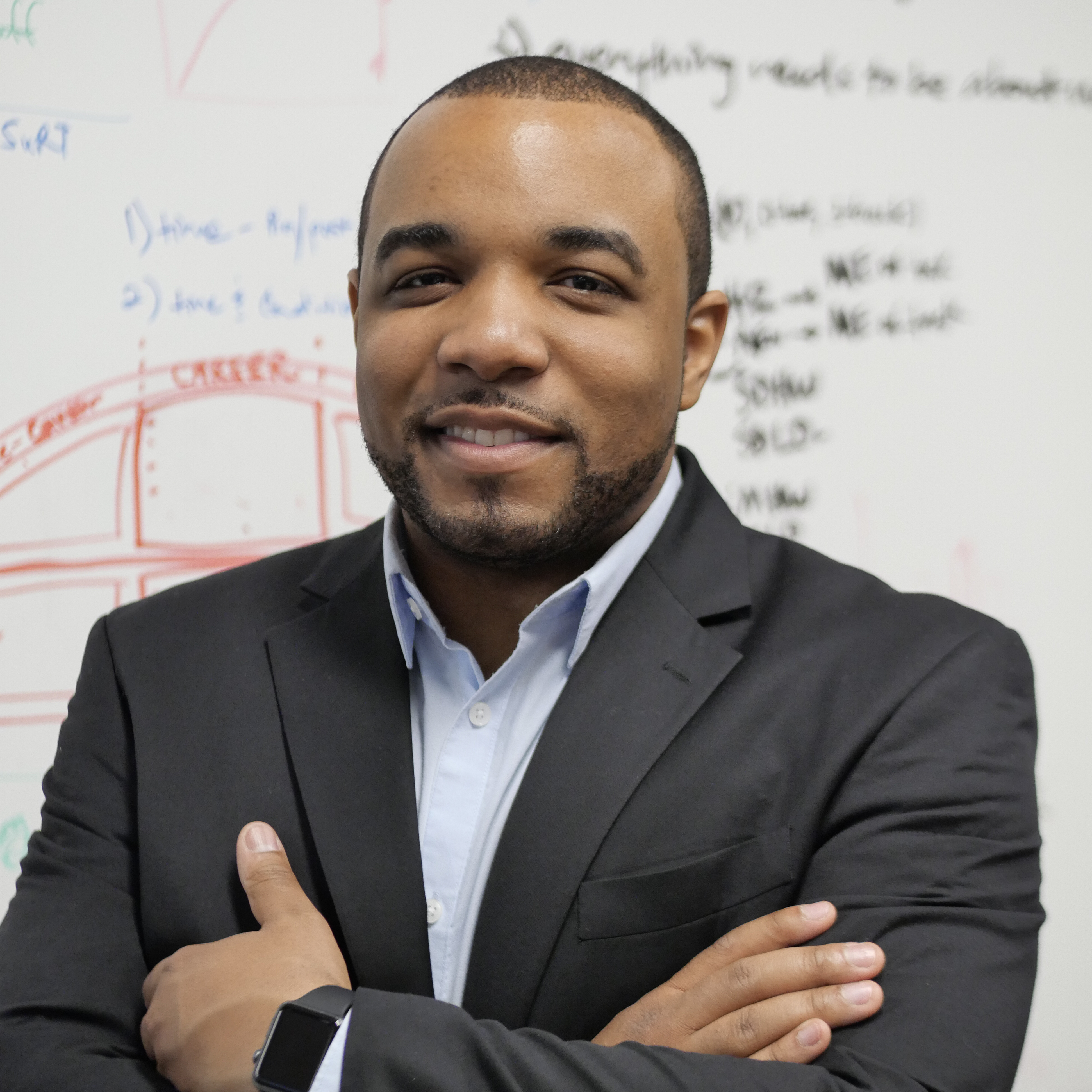
Brandon Pitts, PhD
Associate Professor
Purdue University
Dr. Brandon Pitts is recognized for his work advancing inclusion in human factors and ergonomics by engaging older adults and people with disabilities in research and the design of emerging technologies. His contributions include EASI RIDER, an accessible autonomous-vehicle platform that won the 2022 U.S. Department of Transportation Inclusive Design Challenge and helped establish Purdue University’s Center for Inclusive Design. Through his research on intelligent systems, voice interfaces, and mobility, Dr. Pitts promotes safer, more accessible technologies for populations often underrepresented in technology design.
Inclusion Award for Innovation
Ninica Howard, Dr. Mike Rayo, Dr. Myounghoon (Philart) Jeon and Dr. Sabina Patel are recognized for their leadership in developing the Inclusive HFE (iHFE) program, which expands access to human factors and ergonomics education and professional opportunities for students and faculty from underrepresented communities.
Since 2022, the program has supported scholars through sponsored conference attendance, mentoring, networking, and hands-on experiences, building a more inclusive and accessible pathway into the field and the Human Factors and Ergonomics Society.
Alexander C. Williams, Jr. Design Award

Paul Milgram, PhD
Professor Emeritus
University of Toronto
Dr. Paul Milgram is recognized for inventing and refining the PLATO visual occlusion spectacles, advancing the study of visual sampling and human performance across transportation, medicine, sports, and other fields. His pioneering research in human factors, stereoscopic displays, and augmented and mixed reality has shaped how researchers and designers develop and evaluate augmented-reality systems.
A.R. Lauer Safety Award
.png?ver=TQbPohvywpLoz87ZnzNEbQ%3d%3d "headshot")
Sheila “Charlie” Klauer, PhD
Research Scientist/Associate Professor
Virginia Tech Transportation Institute
Dr. Sheila “Charlie” Klauer is recognized for her pioneering naturalistic driving research, which has transformed the study of driver behavior and crash risk. Her work on distraction, fatigue, and novice drivers has informed transportation laws, international standards, and vehicle-safety technologies, advancing human factors research and helping reduce risky driving behaviors to improve roadway safety.
Hal W. Hendrick Distinguished International Colleague Award

Yordán Rodríguez, PhD
Professor of Ergonomics and Human Factors
University of Antioquia
Dr. Yordán Rodríguez is recognized for his contributions to advancing human factors and ergonomics research, education, and professional practice, particularly in Latin America. He developed ERIN (Individual Risk Assessment), a practical ergonomic method used in dozens of countries to assess workplace risk factors associated with work-related musculoskeletal disorders. Through his research, international outreach, and leadership in ergonomics education, Dr. Rodríguez has advanced the field globally.
Paul M. Fitts Education Award

Anthony D. Andre, PhD
Director
Interface Analysis Associates LLC
Dr. Anthony “Tony” D. Andre is recognized for his lasting contributions to human factors and ergonomics education. During his 33 years at San Jose State University, he co-founded the graduate Human Factors/Ergonomics program, educated more than 1,000 students, supervised over 80 theses and projects, and supported students’ professional development through applied learning, mentorship, and leadership.
Jack A. Kraft Innovator Award
Denny Yu, PhD
Professor
Purdue University
Dr. Denny Yu is recognized for his innovative work in biobehavioral sensing and modeling, particularly his use of computer vision to analyze facial expressions and infer force exertions. His research introduces novel approaches to assessing workplace safety and advancing the field of human factors and ergonomics.
Bentzi Karsh Early-Career Service Award

Vickie D. Nguyen, PhD
Consultant
Human Factors and UX Research
The award recognizes Dr. Vickie D. Nguyen for her sustained service and leadership within the Human Factors and Ergonomics Society and her efforts to extend human factors and ergonomics to healthcare, industry, professional, and student communities. Through communications, mentoring, outreach, health informatics, workplace education, and STEM engagement, she has strengthened HFES and expanded awareness of the field beyond the Society.
Oliver Keith Hansen Outreach Award

Dr. Kermit Davis, PhD
Professor, Graduate Program Director of Industrial Hygiene and Occupational Ergonomics
University of Cincinnati
Dr. Kermit Davis is recognized for his sustained, multisector outreach efforts to broaden awareness of human factors and ergonomics and its benefits to society. His contributions extend beyond individual activities to include outreach integrated into Human Factors and Ergonomics Society programs, creating lasting capacity and impact for both the field and the Society. Through his personal engagement and programmatic leadership, Dr. Davis exemplifies the purpose of this award.
William C. Howell - Young Investigator Award
.png?ver=jor85fQ0jEcBOlw1C8VjAg%3d%3d "headshot")
Ashley Hughes, PhD
Research Informaticist, Associate Professor
Case Western Reserve University; MetroHealth Medical Center
Dr. Ashley Hughes is recognized for her impactful, collaborative research advancing patient safety and quality of care. Her work spans diverse clinical settings and translates research into practice through innovative, externally funded projects focused on improving healthcare outcomes.
Arnold M. Small and Betty M. Sanders President’s Distinguished Service Award

Andrew Imada, PhD
Macroergonomics Consulant
This award commemorates individuals who have made outstanding contributions to the advancement of the human factors profession and HFES over the length of their full career.